My MA thesis will focus on the British poet Philip Larkin, more specifically his relationship with both Modernism and Postmodernism and the impact each literary movement had on his distinct poetic persona. This literature review will list and discuss the main pieces of literature I have been using as part of research for my thesis. I began my research into Larkin with a few questions: What were Larkin’s main issues with Modernism? Where does Larkin fit into Postmodernism? What, and who, significantly influenced his poetic persona? Which poems best display the authentic and sincere side to his writing?
In answering these questions I aim to illustrate that Larkin’s rejection of the literary style of Modernism places him within Postmodernism, but in a manner that is unique. Larkin is frequently associated with The Movement; in researching this I have utilised The Movement Reconsidered: Essays on Larkin, Amis, Gunn, Davie and their Contemporaries.I have also drawn from Sarah Humayun’s PHD thesis, Different from Himself: Reading Philip Larkin After Modernism, completed in 2013 for the University of Edinburgh. Professor Amir Shebl El-Komy’s work Philip Larkin as a Post-Modernist: A Philosophical Approach has proven useful also. Professor El-Komy points out that Larkin frequently equated modernism with “mystification and outrage”.
In relation to Larkin’s relationship with (and disdain for) Modernism I will be futher drawing on much of his own writing; primarily Required Writing and All What Jazz: A Record Diary. All What Jazzfamously sees Larkin refer to Modernism, as an “aberration” that had “blighted all the arts”. Required Writing provides definitive insight into Larkin’s writing process, poetic themes and his feelings on several topics that intersect within my research. Both interviews included in Required Writingprovide vital insight into the poet’s relationship with the media, as well as his occupation as a librarian.
James Naremore’s article ‘Philip Larkin’s “Lost World”’ also discusses Larkin’s disdain for Modernism, as does Theodore Weiss’ ‘The Blight of Modernism and Philip Larkin’s Antidote’. Due to the closure of UCC’s library as a result of the Covid-19 pandemic, I have been researching quite extensively on JSTOR. Other articles which have proven helpful while researching Larkin and Modernism include: ‘Larkin’s Blues: Jazz and Modernism’ by B.J Leggett and ‘Philip Larkin, British Culture and Four Letter Words’ by Ryan Hibbett.
I wish to establish that Larkin’s poetry portrays authenticity and sincerity equal to that of cynicism and melancholy; I am hopeful that my thesis can present Larkin’s work in a different light to the negative portrait that emerged following his death. The writing of Clive James, particularly Somewhere Becoming Rain: Collected Writings on Philip Larkin, provide an excellent defense of Larkin’s reputation:
People of surprisingly high intelligence have managed to convince themselves that Larkin’s poetry didn’t amount to much at all…their dismissal of him makes you wonder whose poetry they think does matter, if his does not.
Clive James / Collected Writings on Philip Larkin
John Osborne’sLarkin, Ideology and Critical Violence: A Case of Wrongful Convictionhas proven extremely useful when researching Larkin’s detractors as well as his place within postmodernism:
His novels and poems sabotage conventional pieties regarding church, state, nationality, marriage, gender, race and capital; and in the process, play a central role in the cultural transition to postmodernist indeterminacy.
John Osborne / Larkin, Ideology and Critical Violence: A Case of Wrongful Conviction
Osborne’s work also further illuminates Larkin’s appreciation for Thomas Hardy, as well as his thoughts on gender, race and politics. Larkin’s admiration of Hardy is a vital aspect of his poetic persona. Required Writingprovides insight into this, in the poet’s own words. Consider the themes noted by Larkin below; are they not all common to his own poetry?
He’s not a transcendental writer, he’s not a Yeats, he’s not an Eliot; his subjects are men, the life of men, time and the passing of time, love and the fading of love.
Philip Larkin on Thomas Hardy / Required Writing
The first major source of biographical information I have drawn from is Maeve Brennan’s The Philip Larkin I Knew, which details her near 30-year relationship with the poet, as both a co-worker and a love interest. Brennan’s book is an excellent source of information on Larkin’s personality as well as his working life. Brennan’s book fills in some gaps surrounding Larkin’s writing; for example, her significant impact on The Whitsun Weddings. The Philip Larkin I Knewtells of how he once described that collection as Maeve’s book! (“You know The Whitsun Weddings is your book, don’t you”.)
In considering which poems my thesis will focus on, I have been primarily using Philip Larkin: The Complete Poems, edited by Archie Burnett. This edition has been particularly useful as it contains annotations as well as pieces that remained unpublished in Larkin’s life time. When considering the themes of authenticity and sincerity in terms of Larkin’s poetic persona, two unpublished pieces have come to the forefront; ‘The Dance’ and ‘To A Friend’, both of which I encountered in Burnett’s edition of collected poems.
To piece together more information on Larkin’s opinions and interpersonal relationships, I have been drawing from the Selected Letters of Philip Larkin 1940-1985, edited by Anthony Thwaite. This collection includes over 700 letters, from Larkin’s late teens, to just before his death. Thwaite’s commentary has been very useful when researching what and who influenced Larkin’s poetic persona, as he was a close friend of the poet for many years. When discussing the importance of Larkin’s letters, and what they reveal about the poet, Thwaite said the following:
All are here in the vividly speaking voice of someone who, even when he was joking, told the truth as he saw it…Philip Larkin who was not only one of the finest poets of our time but also a compulsive letter writer…a kaleidoscope self portrait”.
Anthony Thwaite / Selected Letters of Philip Larkin
While my research is far from complete, the above sources have helped me shape the outlines of my thesis topic. I still have questions to answer, and more books to read but all of the above have provided quite a good start. The next steps in my research will be to watch two documentaries: ‘Philip Larkin: Love and Death in Hull’ and ‘Through the Lens of Philip Larkin’, as well as further establish Larkin’s place within Postmodernism.
Welcome back for what might just be the last time! Something of a bitter sweet post today, as my journey with this blog comes to an end. I find it hard to imagine that I was so nervous about starting all of this up; the blog became one of my favorite parts of the MA experience. I have loved writing in a less formal style than usual and being able to incorporate visual elements, as well as explore and express a variety of my interests. Having read over all my posts, I have to say that I am quite proud of the finished result. I am proud of my reflections and thoughts on what are admittedly varied subjects, but the common thread of my absolute love for literature ties them all together quite nicely, I think.
Its time to look back; the first pieces of research, the early questions, the (often rambling) expressions of thought. This will lead us to perhaps the scariest part of it all – the conclusions! So, buckle up as we go right back to the start, or in other words, October 2019.
October marked the beginning of my classmates and I’s blogging journey; I think it is fair to say that many of us were nervous at the thoughts of putting our work out there in such a public (and consistent) fashion. In all honesty I was also secretly a bit excited, having ran a moderately successful Tumblr blog when I was a teenager.
I will admit that I was nervous when I first heard that we would be expected to write and publish academic blogs. My previous style of blogging was largely visual as I did not have much confidence in my writing abilities, or in expressing my own voice and opinions. Fortunately, I am now a much more confident and self assured person, and this has carried through to my writing and self expression. I am now proud to call myself an Irish poet and a writer; and now as it works out, a blogger!
8th October 2019 – Post one: Stepping Stones
It is somewhat odd to re-read my first ever post. I feel my writing style has actually changed a bit from October to March. While my early blog entries varied, my main man Philip Larkin was on my mind as a thesis topic from day one. When considering what to name my blog, I knew I wanted to incorporate Larkin in some manner, but not have the blog appear to be exclusively focused on the poet. Thus, From a Train Window was born. I must note here that I had no concrete ideas for a thesis title back in October. Larkin was a strong contender of course, but I also considered focusing on the music of Bob Dylan and Bruce Springsteen, or the films of Quentin Tarantino. Indeed even right now, in March, I am still tying up loose ends despite settling fully on Larkin. Life is soup and I am a fork.
My blog name, From a Train Window, was actually inspired by Larkin and one of his more famous musings – “you can look out of your life like a train and see what you’re heading for but you can’t stop the train”.
Stepping Stones
I left a bit of a gap between publishing my first and second blog posts; partly due to a dose of writers block, and partly due to uncertainty as to the direction in which I wished to take the blog. As the weeks went by I became much less uptight and simply wrote about what was important to me. My second blog post was a reflection on Todd Phillip’s Joker, with Joaquin Phoenix in the title role. While not related to class work or my thesis research, this post massively boosted my confidence in blogging.
As November rolled around, life got busy; lots of reading for class, hockey matches every weekend, research, drinking enough water, staying alive. The usual. This month gave me my first taste of an MA assignment; I wrote my very first essay as a masters student on none other than Sigmund Freud.
At the moment, I’m working on my first essay as part of the Theories of Modernity module. I’ve chosen to write about Sigmund Freud’s famous piece Totem and Taboo – not 100% sure I won’t regret this decision but at the moment I’m rolling with it! Freud is, for lack of a better word, an interesting cultural figure. I feel as though almost everyone’s first introduction to the founder of psychoanalysis is of course, the Oedipal Complex; that and the inevitable rejoinder- well I do not want to sleep with my mother, thank you very much. Or father, gender dependent. Protesting against Freud’s theories seems rather like Bill Clinton declaring he did not have sexual relations with that woman; does it matter if he did or he didn’t? Society, or Freud in this case, thinks you did. Too bad, you’re complicit in incest now, simply because you didn’t like your Dad.
November 2nd: Decoding Freud and Other MA Adventures – Hows Your Head?
Freud Portrait by Daniel Fagan – licensed under CC BY-NC-ND 4.0
Working on this assignment was admittedly, very difficult. However, in hindsight, I enjoyed the challenge of piecing together my research and improving my referencing skills. November was a prolific month of blogging for me, and I uploaded one of my most personal posts: This Too Big World: Writing and Healing. I do not wish to draw too heavily from this post as it does not relate strictly to my research, or reflections on my modules, but I am both glad I wrote it, and proud I published it. One of my goals for my blog was that pieces of my personality would be sprinkled throughout. The title is a quote from On The Road the seminal work of Beat poet Jack Kerouac which goes as follows:
“I wished I was on the same bus as her. A pain stabbed my heart as it did every time I saw a girl I loved who was going the opposite direction in this too-big world of ours.”
While I enjoyed Childe Harold‘s depiction of a world weary traveler seeking a satisfying distraction, it was Don Juan that really stood out to me. Don Juan is Byron’s satirical inversion of the legend of Don Juan, a notorious womaniser. Bryon instead chose to portray Juan as the one easily seduced, a tale told in 16 cantos and an unfinished 17th due to his untimely death in 1824.
November 16th: Mad, Bad and Dangerous to Know? Rediscovering the Beauty In Byron
Our classes on Byron remain a highlight of the MA, and produced what is, at least in my opinion, one of my strongest blog posts with some insightful reflections. Here is where I see the blog take on a more reflective tone, and it is where I see myself settle into writing about academic material with greater comfort.
Yet there is such reverence in stanzas 88, 89 and 90 in which the father of a “weaklier child” attempts to nurse him back to health while lost at sea. Byron’s account of fresh rain water coming just a little too late is heartbreaking, and visually flawless. The reader cannot help but see the desperate and heart sick father squeezing “out a rag some drops of rain” in a last effort to preserve his son’s life. These stanzas and the quiet elegance they possess are almost jarring when first reading Don Juan. Is this the same poet who had earlier equated human life to “biscuit casks and butter” and gaily detailed the sailors cannibalism? Critics at the time did not fail to see these occasional and carefully placed moments of beauty in Byron’s work; if anything it further enraged them that he was capable of such lyricism yet instead nose dived into further immorality. Yet it is the stark contrast between Bryon’s frankness and his moments of beauty that make Don Juan such an incredible reading experience; Byron drags you down like the shipwreck only to catch and resuscitate you with his incredible and elegant prose.
November 16th: Mad, Bad and Dangerous to Know? Rediscovering the Beauty In Byron
Speaking of academic material, and as the first of my seminar posts appeared in November, I will now touch on one of the mandatory elements of our blog: posting about two of the Research Seminars held within the School of English. Blog posts on the seminars were not meant to simply be a retelling of what was said; they were to serve as a jumping off point, an inspiration for further thought. I think I achieved this more successfully with my second Seminar post. I first attended Dr Yen-Chi Wu’s paper on the relationship between Irish writers and the New Yorker. While vastly different from my primary areas of research, the seminar was nothing if not refreshing.
The aspect of Yen-Chi Wu’s paper that I found most interesting focused on the female writers Elizabeth Bowen, Mollie Panter-Downes and Mary Lavin. I have to thank Yen-Chi Wu for introducing me to both of these women writers, as I had not read any of their work before this research seminar! Bowen’s short story Everything’s Frightfully Interesting was published in The New Yorker in 1941, and is crucial to understanding her stance on the War. Bowen was an Irish-British writer and much of her work strives to capture the realities of life in wartime London.
November 22nd – November Research Seminar: Dr Yen-Chi Wu on Irish Writers and The New Yorker
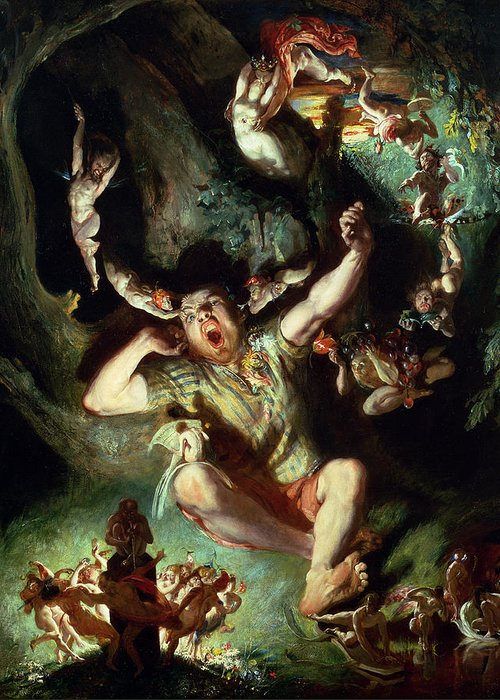
The second seminar I chose to write on for the blog was Professor Goran Stanivukovic’s paper on Daniel Maclise’s painting ‘The Disenchantment of Bottom’. I loved this seminar and took about 4 pages of notes; it was very different to what I had been expecting but that was part of its appeal.
The Disenchantment of Bottom; Focus of the Seminar
This seminar was particularly appealing as it allowed me to tap into my love for art, something I had been somewhat neglecting over the last few months.
Speaking on Irish artists, MacLise’s painting reminded me (curiously enough perhaps) of the work of Harry Clarke, most famous for his stained glass panels. Notably Clarke’s first major commission was for our own Honan Chapel, here in UCC. I found “The Disenchantment of Bottom” particularly reminded me of Clarke’s panel depicting Saint Brendan meeting the unhappy Judas. Note the similarity in the sense of anguish shared between Maclise’s Bottom and Clarke’s Judas: both find themselves in unfamiliar territory, surrounded by shadowy figures. I also see intriguing similarities in the vivid slashes of color and the haunting expressions of the peripheral figures.
February 24th – Keep Your Head: Unraveling the Disenchantment of Bottom
In keeping with discussing the compulsory elements of our module, I wish to include here our Wikipedia Editing assignment. This actually turned out to be much more enjoyable than I thought. I chose to edit the Wiki ‘Relationships that Influenced Philip Larkin’, primarily adding information on his friendship and love affair with Maeve Brennan.
I then moved onto adding information about Maeve’s relationship with Larkin; I was glad to be able to emphasise that while Brennan’s romantic relationship with Larkin lasted for 18 years, their unique friendship spanned three decades; there was much more to Larkin and Brennan than simply a love affair! I also added information on Brennan’s particular impact on Larkin’s poetry; he was in fact, heavily influenced by their relationship. This is particularly evident with his collection The Whitsun Weddings, which he once described as Maeve’s book! (“You know The Whitsun Weddings is your book, don’t you”.)
6th February: Something Wikipedia This Way Comes: EditWikiLit
By the time December and anticipation for Christmas had settled over Cork like a mist, I was exhausted. It is fitting that I only posted once! However, my reflections on the poet John Clare make up what I think is one of my favorite posts on the blog. I absolutely fell in love with Clare’s poetry, as well as his tragic life story; it has been a struggle to only include snippets of the post for my portfolio.
Clare’s poems are so accessible, even if they are sometimes tragic and heart rending to read. Keats and Shelley were master poets, there is no debating that, but sometimes you just are not in the mood for reading Shelley’s Mont Blanc or any of Keat’s odes, regardless of their beauty. This, at least for me, is where Clare comes in; his nature poems are deceptively simple & authentic, focusing on the most simple aspects of the natural world. I deeply recommend reading The Nightingale’s Nest – it is a joy to experience both the easy, serene tempo of the poem, and the sense of wiling the afternoon away beside Clare. Clare was perceptive in ways beyond his own poetry; he saw straight through the city-boy in Keats’ nature poems, once remarking that his contemporary sought “behind every rose bush… a Venus and under every laurel grove a thrumming Apollo”. It is as though Clare speaks directly to every mildly frustrated poetry reader who is looking for even just a drizzle of the real world. If nothing else, for those predisposed to always root for the underdog (me), Clare will steal a little piece of your heart.
December 5th – December Musings: Tracking Down John Clare & Other Pursuits
What I loved most about Clare were his parallels to Larkin; parallels I admit I was surprised to find. The two were so different, after all. However, I could see echoes of Clare in Larkin’s ‘At Grass’.
While the horses may not have the same freedoms as some of Clare’s poetic subjects, each man’s work is a tempered with a consistent respect for the natural world. Larkin goes on his way without bothering the horses; he is capable of recording his musings without disturbing their peace. Clare is similar; his love for the natural world can be encapsulated in a line from The Nightingale’s Nest: “we’ll leave it as we found it”.
December Musings: Tracking Down John Clare & Other Pursuits
Image from Simon Matzinger via Unsplash / unsplash.com
I will readily admit that I have been dreading the moment I reached January when writing this portfolio. It was the hardest month of my life, and I have not been the same since. My friend, Cameron, was murdered and everything I have written after that night has been touched with a grief I would not wish on anyone. I threw myself into my research throughout January, and began to see the direction my thesis on Philip Larkin would take. This was the one positive of having to distract myself. On the 29th of January I wrote “All this, simply to be where you are: Friendship as the Greatest Love in Life”. Aside from touching on my own friendships, I was pleased to be able to further illuminate Larkin’s relationship with Maeve Brennan, for whom he wrote ‘The Dance’. Writing this post helped me realise how important it was to me that my research could highlight the softer, less cynical side of Larkin.
Although Larkin and Brennan’s relationship did not have a fairy tale ending, her respect and love for him remained consistent right up to the end of the poet’s life. Brennan wrote that the Larkin she knew was a “stimulating companion, witty, urbane, great fun to be with”. Her Philip was a man of “good-natured humor, great tenderness and inspiring idealism”. Indeed, so great was her loyalty to Larkin they were even linked in death: the epitaph on her grave is the famous “what will survive of us is love”.
29th January – “All this, simply to be where you are”: Friendship as the Greatest Love in Life
Larkin and Maeve Brennan / image sourced from Pinterest
As written above, February brings the rain. I would like to say that this month brought me some healing; I certainly made the effort to write and blog a substantial amount. February brought a welcome distraction in the form of the Academy Awards, an event I look forward to every year. This year in particular, I was excited; my favorite actor, Joaquin Phoenix, looked set to finally receive the appreciation he deserved. “Run to the Rescue with Love & Peace will Follow”: Joaquin Phoenix, The Oscars & The Forever in Grief is worth reading if you adore film as I do, even if just to re-watch Phoenix’s beautiful acceptance speech.
I have made it my mission to not allow grief to make my heart hard and cold: love and kindness are the most precious gifts we can give.
11th February: Run to the Rescue with Love & Peace will Follow”: Joaquin Phoenix, The Oscars & The Forever in Grief
Church Going is Larkin at his softest but it is (thankfully) not without his humor. Note the poet’s observation that the silence was “brewed God knows how long”; while of course, God could quite literally know how long is has been silent, it is also the poet’s gentle way of showing his indifference. This line has also always seemed somewhat philosophical to me. Much like the silence’s length, only God knows how many men have stood in it, searching for answers just as Larkin did. Larkin himself declares that he is “at a loss” about what he is truly seeking every time he finds himself in churches, eventually concluding that perhaps he is drawn there simply because so many others have felt the same lure before him.
March 18th: Awkward Reverence: Finding Faith in Philip Larkin’s ‘Church Going’
This brings us to the last month of my MA blogging experience: March 2020. It was a month that was mostly filled with Larkin, and Mini Conference prep. I shaped most of my ideas in David Becoming Goliath: Larkin’s Lifelong Revolt Against The Giants of Modernism. The conference was unfortunately cancelled due to Covid-19. However, we still hosted a sort of virtual conference as best we could, by posting our papers online. I won’t spoil too much of my research here: you can read it all over on Textualities 2020: Live and In Isolation – Modernism? I Don’t Even Know Him. I am hopeful that all of my mini-conference prep will significantly help me while writing my thesis on Larkin’s poetic persona.
Today I will be presenting research on the British poet Philip Larkin: specifically, his rejection of the literary movement of Modernism. I will approach this by discussing Larkin’s differing responses to T.S Eliot and Thomas Hardy, with an aim to illustrate how these responses contribute to Larkin’s distinct poetic persona.
21 March – Textualities 2020: Live and In Isolation – Modernism? I Don’t Even Know Him
Some other March highlights include No Place Like Home? Longing, Loss & Larkin’s ‘Home is So Sad’. I really encourage everyone to read ‘Home is So Sad’ it is an utterly beautiful poem. While these reflections did not necessarily fit into my thesis topic, I still feel they are important.
Views from Home / Photo my Own
‘Home is So Sad’ raises questions that I have often sought to answer in my own poetry. What really is a home? Is home not a place but its people? How can a home call itself a home when there is nobody left to make it one? The answer to many of these questions may be as simple as memories: the ghosts left behind long after we leave a place.
17th March – No Place Like Home? Longing, Loss & Larkin’s ‘Home is so Sad’
Time to glance at my last post! Honestly I’m a little bit heartbroken its all over; I have loved blogging. It has been some much needed therapy. My last post was Friends Never Say Goodbye: Signing Off. Its a lighthearted piece to round off the last few months. I simply included my favorite unpublished Larkin poem, as well as some musical numbers from The Road To El Dorado, namely the song from which the post’s title was born.
Some of the best of Larkin / piece unpublished in his lifetime / photo my own
But isn’t that the beauty of literature and film? Even in times like this, and even with the piece of my heart that shattered with my friend’s death, the most deceptively simple things can bring comfort and peace.
March 26- Friends Never Say Goodbye: Signing Off x
I am exposing myself here as hating goodbyes; most likely because I never got to say it to my friend. So I will just say thank you for reading along with my MA journey, and I hope you both enjoyed and took something from it. Stay safe, tell the people you love that you love them. ❤ I will leave you with two final things; the words of Larkin, and a glimpse of the party the world will have when isolation ends.
We should be careful of each other, we should be kind While there is still time. – Philip Larkin.
The greatest live performer of all time – The Boss ❤ The world is quiet without you. Missing you always.
Works Cited:
Brennan, Maeve. The Philip Larkin I Knew. Manchester University Press, 2002.
James, Clive. Somewhere Becoming Rain: Collected Writings on Philip Larkin. Picador, 2019.
Larkin, Philip. The Complete Poems. Edited by Archie Burnett. Faber and Faber, 2012.
Larkin, Philip. All What Jazz: A Record Diary. Faber and Faber, 1970.
Leader, Zachary. The Movement Reconsidered. Oxford University Press, 2009.
Thwaite, Anthony. Selected Letters of Philip Larkin 1940-1985. Faber and Faber, 1922.
Humayun, Sarah. Different from Himself: Reading Philip Larkin After Modernism. University of Edinburgh, 2013.
Motion, Andrew. ‘Philip Larkin & Me: A Friendship with Holes in It’. New Yorker, 2017.
Moeyes, Paul. ‘The Return to The Native: Time and Tradition in the Poetry of Philip Larkin’. (Chapter in In Black and Gold: Contiguous Traditions in Post-War British and Irish Poetry).
Osborne, John. Larkin, Ideology and Critical Violence. Palgrave, 2007.
Welcome back to my last (!!!) personal blog post. The next two pieces uploaded will be my portfolio submission and my literature review. Studying, researching and blogging as usual has been difficult for me lately; the uncertain world we are all now living in has begun to weigh on me. As selfish as it may sound, I miss seeing my friends every day. I miss going out as I please, having a drink and heading to the beach or for a long walk. However, self isolation is for the good of everyone and flattening the curve must be our priority. But I think it is okay to admit that it has been a struggle to not see our loved ones and live our daily lives. I am keeping going by noting that with each day that passes we are one step closer to normality and a healthy society.
‘Days’ by Philip Larkin / Photo my own ❤
I am blogging today mainly to share a few pieces of literature and music that have provided some comfort over the last few days of isolation. This will not be a long post or even a very academic one, but I wished to finish out my MA posts with something softer before uploading my portfolio (which should still be a good read) and my literature review (probably not as exciting). One of my main goals while researching for my MA thesis has been to not lose sight of my love for Larkin’s poetry; in other words to not get too caught up in the academic nature of everything. Not every piece has to fit my thesis topic. I don’t have to analyse everything. I have been reading several pieces that were not published in Larkin’s lifetime and wish to include one of my favorites, ‘To a Friend’, here. I personally feel this is one of Larkin’s most beautiful poems, and much like his work ‘The Dance’ it is tragic that it went unpublished. I know that much of my writing in 2020 has been tempered by grief- I hope that it has not been too morbid- but this poem provided me with an overwhelming sense of comfort. ‘To a Friend’ was published by James Booth in 2002, and the poem is an imitation of W.H. Auden’s ‘Lullaby’ which you can read here. In an interesting aside, it seems Larkin himself did not think much of the poem, as his notes read “I don’t know! this has its points”; but he later humorously concludes “so has a porcupine”. We’ve all been there.
‘To a Friend’ / Philip Larkin – photo my own
I have also been enjoying reading Larkin’s interviews over the years; particularly his conversation with Robert Phillips for the Paris Review in 1982. If anyone is interested in learning more about Larkin I highly recommend reading the above interview as well as his chat with Miriam Gross for The Observer. Both of these interviews can be found in Required Writing: Miscellaneous Pieces 1955-1982. In each of these conversations one can see real glimpses of the poet’s personality and humor, as well as his remarkable habit for self deprecation. Robert Phillips remarked that despite Larkin’s noted dislike for interviews, he had “responded generously”. (This is absolutely true also; it is rare to read an interview in which the poet did not give detailed answers). Larkin however, responded to this by stating “I’m afraid I haven’t said anything very interesting”. As I promised that this blog post would not be too long and would provide some light isolation reading, I will finish up today’s points on Larkin with a favorite anecdote of mine.
Probably my notion of poetry is very simple. Some time ago I agreed to help judge a poetry competition—you know, the kind where they get about 35,000 entries, and you look at the best few thousand. After a bit I said, Where are all the love poems? And nature poems? And they said, Oh, we threw all those away. I expect they were the ones I should have liked.
Philip Larkin to Robert Phillips for Paris Review 1982 / Required Writing
In a move away from Larkin, I recently rewatched The Road to El Dorado (2000) and I have to say, as with many Dreamwork’s films, it is criminally underrated. Aside from the almost crushing wave of childhood nostalgia, and the somehow new realisation that Elton John provided most of the music, I was struck by its depiction of friendship. The movie follows two con artists, Tulio and Miguel, who after acquiring a mysterious map, find themselves in the mystical city of El Dorado, where they are mistaken for Gods. The film has some really fun musical numbers; notably ‘The Trail We Blaze’ and ‘Its Tough to be A God’.
Worth watching if you need some cheering up during isolation 🙂
However, the real standout for me was one of the film’s final songs: ‘Friends Never Say Goodbye’. Hearing this song as an adult was like hearing it for the first time, and I’m not ashamed to admit I cried just a little bit. But isn’t that the beauty of literature and film? Even in times like this, and even with the piece of my heart that shattered with my friend’s death, the most deceptively simple things can bring comfort and peace. I think including ‘Friends Never Say Goodbye’ is a nice note to wrap up the blog on. And it is more than just a little reminiscent of the underlying message of another childhood favorite, Peter Pan. As always, thank you for reading! ❤
“Never say goodbye because goodbye means going away and going away means forgetting.” – Peter Pan
Wrapping up my final MA blog post: I hope you’ve enjoyed the journey ❤
Hello again! Yesterday, Friday the 20th of March, was intended to be the Textualities mini-conference. Unfortunately, the conference was cancelled due to the current Covid-19 outbreak, and the resulting closure of UCC. The right and most responsible decision of course! My fellow MA students and I would have been showcasing strands of our thesis research had the conference gone ahead; however, you can still see a glimpse of my research here on the blog! I (shockingly) was going to present on Philip Larkin. I will attach my research paper here, with some- mostly visual ala Pecha Kucha -additions to liven it up into a blog post! 🙂
Philip Larkin’s revolt against the “Aberration of Modernism” / Photo by Humphrey Ocean / CC BY-SA 4.0 / Would have been slide one!
Philip Larkin’s lifelong rejection of Modernism: T.S Eliot, Thomas Hardy and The Poetic Persona
Today I will be presenting research on the British poet Philip Larkin: specifically, his rejection of the literary movement of Modernism. I will approach this by discussing Larkin’s differing responses to T.S Eliot and Thomas Hardy, with an aim to illustrate how these responses contribute to Larkin’s distinct poetic persona.
To begin I will provide some brief background on Larkin. He was born in Coventry, England in 1922, the only son of Sydney and Eva Larkin. It was the poet’s father who first introduced his son to the works of T.S Eliot and Ezra Pound, writers central to the Modernist school of thought Larkin would come to detest. Larkin was not a prolific writer, only publishing four collections of poetry in his lifetime; he also wrote two novels and was The Daily Telegraph’s Jazz critic for 10 years. He famously worked as university librarian at Hull University for thirty years, and was offered, but declined the position of Poet Laureate in 1984.
Before discussing Larkin’s own feelings towards Modernism, I wish to highlight some central characteristics of Modernist writing, as well as provide examples of key Modernist texts. Confining Modernism to a specific time period can prove difficult, however the general consensus is that the movement lasted from the early 1900s into the late 1940s. Essentially, Modernism was born in a period of extreme change and can be read as a response to several events: notably war, industrialization and the rapid growth of an urban society. Modernist writing is characterised by, amongst other things, its symbolism, fragmentation and distinct experimentation. Some of the most prominent examples of Modernist writing include T.S Eliot’s ‘The Wasteland’, Virginia Woolf’s Mrs Dalloway, James Joyce’s Ulysses and Ezra Pound’s ‘In A Station of The Metro’.
Above images from genius.com and medium.com respectively
So, following on from this, what was Modernism to Larkin? For the poet, Modernism represented a world of “classical and biblical mythology”, both of which meant “very little” to him. (John Press / A Map of Modern English Verse). In fact, Larkin went as far as to describe Modernism as “an aberration” that had “blighted all the arts”. He once famously referred to the writing of T.S Eliot and Ezra Pound as “the culture-mongering activities of the Americans”. (Larkin / Required Writing). Both the classical and biblical mythology mentioned above are trademarks of the poetry of both Pound and Eliot. The critic James Naremore has noted that Larkin took “every opportunity to attack the Modernist giants”. (Philip Larkin’s “Lost World”). This statement is certainly true, and it was not just Modernist poetry Larkin remained unimpressed by. He did not respond kindly to Charlie Parker (ruined jazz in Larkin’s eyes) or Pablo Picasso (made art that was culturally elitist).
Charlie Parker – described by Larkin as a “paranoiac drug addict” / Photo: William P Gottlieb/Ira and Leonore S Gershwin Fund Collection, Music Division, Library Of Congress.
However, it was the American T.S Eliot, considered one of the most important Modernist writers, that Larkin took particular issue with. Eliot has been described as the ‘Father’ of the movement, with his poem ‘The Love Song of J. Alfred Prufrock’ considered its masterpiece. I find Larkin and Eliot’s disagreement somewhat fascinating; it appears, at least to the modern reader, to be a clash of the Titans. Goliath versus Goliath if you will.
The Father of Modernism, the great T.S Eliot & Larkin’s worst offender. Image was center stage on one of my slides and has to be my favorite photo of Eliot, taken by Cecil Beaton in 1956. / Image National Portrait Gallery Website
Larkin declared that Eliot had given the Modernist movement its fundamental “character” with the latter’s statement that poetry and difficulty must be mutually exclusive; In a 1921 review for The Metaphysical Poets, Eliot gave his opinion that “poets in our civilisation, as it exists at present, must be difficult”. This is quintessential Eliot; consider the heavy symbolism and experimental style evident in his poetry. Larkin further stated that Eliot’s drive for “difficult” poetry was hugely detrimental to the “general reader”; the Modernist “demand” for poems that “needed elucidation” had effectively destroyed the once strong connection between poetry and the public. (Larkin, Required Writing). In Larkin’s eyes, this was the greatest sin of Modernism. I wish to emphasise that Larkin’s dislike of Modernism did not stem from a simple hatred of anything new and experimental. This is a popular misconception that he addressed himself, stating “I dislike such things not because they are new, but because they are irresponsible exploitations of technique in contradiction of human life as we know it”. (Osborne, ‘Larkin, Ideology and Critical Violence’).
Photograph by D. Bayes/Lebrecht. / The New Yorker
I put major effort into finding Larkin’s Simon Cowell moment; the kind of poetry that needed elucidation ? Insert Britain’s got Talent buzzer noise here!
What, then, are the main differences between Eliot and Larkin? What did Larkin prize in poetry? How did his aversion to mysticism and symbolism shape his poetic persona? I wish to touch on this by considering Larkin’s ‘Church Going’ next to Eliot’s ‘Journey of The Magi’.
‘Church Going’ is an excellent example of Larkin’s deliberately ironic and practical persona. He had a sceptical attitude towards Christianity and organised religion in general; I will again emphasise Larkin’s comment that the “whole world of classical and biblical mythology” meant “very little” to him, as well as his remark that as a poem, ‘Church Going’, is “not religious at all”. Eliot, on the other hand, wrote ‘Journey of the Magi’ the year after he converted to Anglo-Catholicism; following this conversion the reader can see his poetic persona take on a staunchly religious tone. I consider ‘Church Going’ and ‘Journey of The Magi’ to be a prime example of Larkin’s irony and practised awkwardness meeting Eliot’s mysticism. Consider Larkin deliberately feigning ignorance of religious paraphernalia, describing it as only “some brass and stuff, up at the holy end”. Larkin strove to place value on the traditions and occasions within the life of the everyday English man. Eliot’s ‘Journey of the Magi’ is a celebration of the mystical biblical world, a world filled with “an alien people clutching their Gods”.
If men like Eliot and Pound were the representation of an “aberration”, who was it that Larkin found common ground with, and even took inspiration from? The answer, perhaps surprisingly, is Thomas Hardy, novelist, poet and Victorian realist. Larkin discovered Hardy in 1946, a discovery that enabled him to move away from the influence of W.B Yeats and find his own poetic voice. In Larkin’s own words, discovering Hardy helped him figure out what life was truly about. His appreciation for Hardy’s poetry stemmed from the fact that Hardy was “not a transcendental writer”; he was “not a Yeats… not an Eliot”. (Larkin, Required Writing). Hardy’s poetry focused on the lives of ordinary men, the passing of time and love and its absence; these subjects were equally favoured by Larkin with his aversion to myth and allusion. One can clearly see the influence of Hardy on Larkin’s distinct poetic persona: both men wrote about life as they knew it.
Thomas Hardy looking dapper for one of my final slides! Fascinatingly enough, Modernist Ezra Pound also lauded Hardy’s poetry, establishing that Larkin perhaps had more in common with the Modernists than he thought. / image Wikipedia & National Library of Congress http://loc.gov/pictures/resource/ggbain.13585/
In conclusion, Philip Larkin viewed Modernism as a movement with “no lasting power”. (Larkin, All What Jazz). While this statement came to be inaccurate – Eliot, Pound and many other pioneers of Modernism are still widely read and taught – Larkin’s rejection of Modernism and responses to Eliot and Hardy certainly had a significant impact on his poetic persona. I intend to carry on my research into Larkin with my thesis, and I am hoping to examine further the connection between Larkin, the so-called ‘Hardy line’ and the poetic persona. I also intend to keep researching Larkin and Eliot’s differing approaches to similar themes, for example God and Faith.
Philip Larkin: The Complete Poems / Edited by Archie Burnett
Philip Larkin / All What Jazz: A Record Diary 1961 – 1971
John Osborne / Larkin, Ideology and Critical Violence
James Naremore / Philip Larkin’s “Lost World” / Contemporary Literature, Vol.15, no.3, Summer 1974, page 3.
The above paragraph concludes my conference paper! While I am of course disappointed that we did not get to do the conference as intended, I am delighted to still be able to showcase my research in the next best way! My interest in the connection between Hardy and Larkin has grown while putting together my research; I have been re reading Larkin’s collected poems and spotting similarities and overlapping themes. Despite several mindmaps I am still not 100% sure which direction I wish to take my thesis in. However, I am confident that it will come to me over the next while! My research for the mini-conference has already proven invaluable, as I know Larkin’s distinct poetic persona will definitely be a substantial part of my eventual thesis title. Make sure to check out my classmate’s blog posts on their research and keep an eye on #Textualities20 ❤ Thank you for reading! Some more isolation blog posts will be coming soon!
Views from home – Banna Strand, County Kerry / Photo my own
Welcome back! I hope this post finds everyone safe and well, in what is a very uncertain time ❤ The concepts of home and place have been on my mind quite a bit recently. I’d imagine much of it is due to how much time we have all had to spend indoors! I visited my boyfriend’s home in West Cork for the weekend and was able to catch up on some reading for assignments and thesis research; while I am still not 100% certain which aspect of Larkin’s writing I wish to focus on, I have been narrowing down my focus to certain pieces of poetry. I have always felt extremely grateful to have a home from home in Schull; the scenery and peaceful days spent there have given me some of my most cherished memories with my partner.
While my family home is here in Cork City, I was born and spent most of my early childhood in Kerry. The majority of my family still live in Tralee, and visiting is always somewhat bittersweet. The mountains and beaches so familiar to me are as beautiful as ever, but changes in the streets and shopfronts are always somewhat disconcerting. Visiting home often reminds me of how much our sense of place can shift due to even minor changes. How do we adapt to this? I no longer like driving down the road where my childhood home is; passing by the gates and seeing the trees I scaled like a monkey fill me with a certain sadness. The memories I made there with my brother are precious to me. They hang in my heart like Christmas baubles wrapped in tissue paper, both beautiful and fragile. I sometimes feel they are better left alone and undamaged. I think for many of us home and heartache can be intertwined; this leads me to discussing Philip Larkin’s short, but incredibly effective poem, ‘Home is So Sad‘.
Larkin with his mother Eva, and his aunt Nellie in 1958, the same year he wrote ‘Home is So Sad’ // photo estate of Philip Larkin
Larkin completed this piece on New Year’s Eve in 1958 while he was staying at his mother’s house in Loughborough. Much has been made of Larkin’s difficult relationship with his family, yet the poet wrote to his mother, Eva, with remarkable frequency, and wrote several of his most moving poems while visiting her. Larkin’s father, Sidney, is certainly a controversial figure: a man who not only had a statue of Hitler on his mantelpiece, but twice attended Nuremberg rallies. The poet once described his father’s letters as “utterly detached, cold and impersonal”. But I digress! ‘Home is So Sad’ raises questions that I have often sought to answer in my own poetry. What really is a home? Is home not a place but its people? How can a home call itself a home when there is nobody left to make it one? The answer to many of these questions may be as simple as memories: the ghosts left behind long after we leave a place. Larkin touches on the idea of memories, and the tangible mark they leave behind. There is the curiously painful suggestion that maybe if you looked just carefully enough you could once again see those who have left. Larkin compares the home to a plant that needs watering: it is left “bereft” following its losses, and subsequently “withers”.
“You can see how it was: look at the pictures and the cutlery. // The music in the piano stool. That vase.”
Philip Larkin / Home Is So Sad
In these lines you can see the magic of Larkin: he deliberately places cutlery in the same place as more traditionally sentimental objects like photos and music. Because of course, seemingly innocuous objects like a fork or a chipped spoon, are every bit as vital to our sense of home and place as the carefully curated photo albums and exotic vases. It is often the quiet memories in a home that we cherish. There are so many large, colorful occasions in our lives, but we are privileged if we have experienced the tiny moments like handing a loved one a worn mug, or simply eating together with much loved cutlery. I also wish to draw attention to another clever poetic technique favored by Larkin, the list. Larkin uses lists to slow down his poems, which allows the reader to focus on the carefully chosen objects. Larkin is not a poet who uses unnecessary words, with poems that are concise and to the point.
The line “it stays as it was left” has always stood out to me as marking the poem very distinctly with the theme of longing, or loss. While in some ways this statement could be a positive, i.e. your home will remain your home no matter how much time passes, Larkin’s use of run on sentences only compounds the sense of sadness. Perhaps my reading of the poem is tempered by my own grief over the loss of my friend, but I find the sense of a place once so filled with love and light left empty, waiting desperately for its return incredibly sad. While there is beauty in things that do not change, like the previously mentioned photographs, there is grief too. One can hope love and light will continue to touch both a home, and the people who made it one.
“It stays as it was left, shaped to the comfort of the last to go / As if to win them back”.
My musings on this poem have led me to conclude that nothing can ever stay the same: even our memories become tempered by our experiences. Adapting to change is a fundamental yet often unwelcome part of life. I think the best way to process it is to cherish past moments but aim to move forward and make new ones, even in the wake of loss. Considering loss and its impact on our sense of home and place reminds me of one of the new songs Alan Menken and Tim Rice wrote for 2017’s Beauty In The Beast: ‘Days in The Sun’. Intended as a replacement for the original film’s ‘Human Again’, the new inclusion sees the once human servants reflecting on both their loss, and their hope that light will return to the castle once more.
Home, whatever that may be to each individual, is shaped by the people that form the intrinsic pieces of it. I feel grateful to have left a piece of my heart in each place I can call home: Kerry, Cork City, and West Cork. I hope that none of these places will ever become bereft. ‘Home is So Sad’ is another excellent example of the softer, less abrasive Philip Larkin, something which I have wished to highlight throughout my blog posts. Of course, if nothing else, Larkin was a man filled with contradictions, and ‘Home is So Sad’ is no exception. For a man who wrote so eloquently on the emptiness after a loss, and a changing sense of place, when his mother spoke of her loneliness as a widow, Larkin simply replied “a few hours of anyone is always enough for me”. Something tells me the current era of self isolation and social distancing would have suited him just fine. Thank you for reading these rambling reflections ❤ Wishing everyone peace, good health and a safe place to call home, no matter where you find yourselves in the world.
To brighten up the isolated days:
The always brilliant Billy Joel
One of my favorites of all time – soothes the soul
Welcome back! I have spent the last few weeks continuing my research on Philip Larkin, and have begun to narrow my focus down to Larkin’s relationship with Modernism and Post Modernism. I am also working towards the upcoming Mini Conference, in which my classmates and I will present our research. I am hoping to showcase my research on Larkin’s rejection of Modernism, his links to Postmodernism and how these literary relationships enabled him to present a sincere and authentic poetic persona. Forgive me if this post seems somewhat convoluted or confused, I am still working through my research so far in my own mind. Laying it out here on the blog should hopefully help!
I think it is more than fair to say that Larkin was utterly opposed to Modernism. In his own words the movement was an “aberration” that had “blighted all the arts”. (1). So, yeah, not a fan. Much of Larkin’s gripes with Modernism stem from his disdain of the world of “classical and biblical mythology”, both of which are characteristic of the poetry of behemoths such as Ezra Pound and T.S Eliot. (2). When I first discovered Larkin, I was drawn to the straightforward and uncompromising language he used. In other words, I never felt as though I was struggling to understand his message, or that I was always on the verge of looking things up to grasp the poem fully. The accessibility of Larkin is what set me on the path of examining the sense of sincerity or authenticity in his poetry; even with his more brutal pieces there is always a strong sense of reality. Coupled with the excellent advice of Professor Alex Davis, the idea to connect a rejection of Modernist ideals with Larkin’s own particular brand of postmodernism was born!
Larkin’s relationship with the poetry and poetic ideals of T.S. Eliot have been particularly fascinating to research. I have taken Eliot as a starting point for my research into Larkin’s rejection of Modernism for several reasons; “The Love Song of J. Alfred Prufock” being considered a masterpiece of the Modernist movement, Eliot’s extensive comments on poetry and poetic principles, and Larkin’s own responses to both. This is not to say that Eliot was Larkin’s main target. He also took issue with Charlie Parker (ruined jazz in Larkin’s eyes), Ezra Pound and Pablo Picasso. The three P’s if you will. However, in this blog post I think I will mainly highlight what I have been piecing together about Eliot and Larkin, as I imagine it will form a large part of the roughly 8 minute mini conference presentation coming up this month!
In a 1921 review of metaphysical poetry, Eliot wrote the following:
We can only say that it appears likely that poets in our civilization, as it exists at present, must be difficult. Our civilization comprehends great variety and complexity, and this variety and complexity, playing upon a refined sensibility, must produce various and complex results.
T.S Eliot / 1921 / ‘The Metaphysical Poets’ Times Literary Supplement, 20 October 1921
Larkin remained unimpressed by the sentiment that poetry must be obscure, and even ‘above’ the common reader. In an essay for John Betjeman, Larkin commented that “English poetry went off on a loop-line that took it away from the general reader”. He was particularly opposed to the Modernist “demand for a kind of poetry that needed elucidation”. (3). The more I research on Larkin’s relationship with poets like Eliot, the more it became clear that he became almost a living contradiction of Eliot’s principles. In his piece “Philip Larkin as a Postmodernist: A Philosophical Approach”, Professor Amir Shebl El-Komy characterises Larkin’s poetry as “an empirical, anti-heroic, anti-transcendental poetic form”, writing that is “skeptical and commonsensical”.
When discussing Larkin and Modernism, it is vital to mention what critics have described as Larkin’s ‘literary conversion’ from Yeats to Hardy. Again I must credit Professor Davis for reminding me of its importance! Discovering Hardy’s poetry was for Larkin, a major turning point in his own writing career. Prior to this, Larkin’s writing was heavily colored by the influence of William Butler Yeats and W.H. Auden, two of the greatest poets to have ever written in the English language. (At least in my opinion!). When discussing Larkin and Hardy, one must note that Hardy’s influence on Larkin’s poetry did not come in the form of style, but content. When speaking on BBC Radio 4 in 1968, Larkin explained the roots of his appreciation for Hardy:
I was beginning to find out what life was about, and that’s precisely what I found in Hardy. In other words, I’m saying that what I like about him primarily is his temperament and the way he sees life. He’s not a transcendental writer, he’s not a Yeats, he’s not an Eliot; his subjects are men, the life of men, time and the passing of time, love and the fading of love. . . . . . . . . . . When I came to Hardy it was with the sense of relief that I didn’t have to try and jack myself up to a concept of poetry that lay outside my own life –– this is perhaps what I felt Yeats was trying to make me do. One could simply relapse back into one’s own life and write from it. Hardy taught one to feel rather than to write — of course one has to use one’s own language and one’s own jargon and one’s own situations — and he taught one as well to have confidence in what one felt. I have come, I think, to admire him even more than I did then.
Philip Larkin, “The Poetry of Hardy,” in Required Writing: Miscellaneous Pieces 1955-1982. Sections underlined for emphasis by me!
I find Larkin’s musings on Hardy to be very important: here we can see Larkin noting that much of Hardy’s appeal and influence was that he was quite simply not Eliot. And by not being Eliot, he symbolised a writing style removed from Modernism. I also would like to note the difference Larkin sees between transcendental poetry and writing, as opposed to works that focus on the lives and times of ordinary men and women. I have touched on this in some previous posts; one aspect of the enduring appeal of Larkin’s writing is its efforts to show how it is to live on an every day basis, as opposed to seeking meaning through philosophical systems, or heroic myths.
Following the vein of myth, an area I am particularly interested in exploring further is that of God and Faith within Modernist and Postmodernist poetry, comparing, for example Eliot’s “Journey of the Magi” to Larkin’s “Church Going”. (You can find a blog post on Church Going here). “Church Going” is Larkin at his ironic and skeptical best, and is a firm step away from Eliot’s mysticism. I will draw attention again to Larkin’s comment that the “whole world of classical and biblical mythology” meant “very little” to him, as well as his remark that as a poem, “Church Going”, is “not religious at all”. Eliot on the other hand, wrote “Journey of The Magi” the year after he converted to Anglo-Catholicism; the reader can see his poetry take on a decidedly religious character with the publication of the Ariel Poems and “Ash Wednesday”. However I do not wish to spoil all of my research in this post!
I should probably note here that I neither love or loathe Eliot, and I also wish to emphasise that this blog post is in no way meant to be read as anti-Eliot, or ‘Eliot BAD, Larkin GOOD’. Is it a somewhat rare sentiment to fall between the two stools of love and hate when it comes to Eliot? I enjoy reading and exploring his poetry, particularly his undeniably masterful treatment of themes like alienation. “The Love Song of J. Alfred Prufock”, “The Waste Land”, “The Hollow Men”: I acknowledge that I am richer for reading them. Yet I do not seek them out, or return to them again and again as I do with Larkin. However, I have no intentions of allowing my personal preferences to cloud my research. I only make the above points to highlight that researching Larkin comes somewhat more naturally to me! And of course, an exploration of Modernism could not be undertaken without discussing T.S Eliot and his remarkable influence.
I would like to wrap up this blog post with two fascinating pieces of information I came across this week! The first of which relates to the British artist Damien Hirst, who dominated the arts scene during the 1990s, and remains iconic for pieces such as The Physical Impossibility of Death in the Mind of Someone Living. (Read actual tiger shark preserved in formaldehyde). Perhaps surprisingly, Larkin has been a significant influence on Hirst. Please have a look at the attached article on Hirst’s installation, inspired by Larkin’s collection High Windows.
Hirst went on to publish the book Superstition to accompany the butterfly paintings, and the book is credited as the work of both Hirst and Larkin. Hirst used Larkin’s work in High Windows as a point of reference to focus on death and love. The book also includes 6 of Larkin’s poems, and an introduction by the Irish writer John Banville!
Cover of Hirst’s book Superstition, which discusses the influence of Philip Larkin
The second piece of information comes back again to Eliot, and is a humorous conclusion for today’s post. I was delighted to read in a Guardian article that Eliot read “The Waste Land” to the Queen Mother when she was a younger lady; however, she didn’t understand any of it, resorting to giggling throughout. Who would have ever thought I could so deeply relate to the Queen Mother? Republicans forgive me. Thank you for reading a post that is mostly me figuring out my own thoughts!
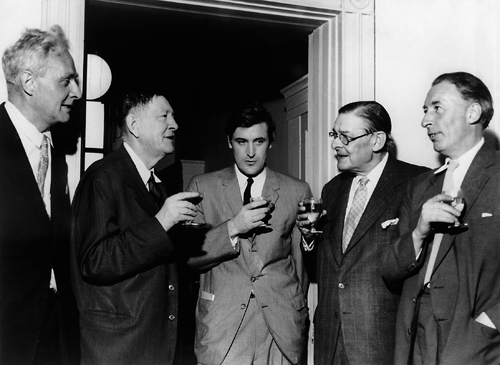
One last thing! How fascinating is this photo? From left to right, Stephen Spender, W.H. Auden, Ted Hughes, T.S. Eliot and Louis MacNeice. (Known as the Faber poets).
Works Cited:
James Naremore, Philip Larkins “Lost World” / Contemporary Literature, Vol 15, No 3, Summer 1974
Quoted by John Press, A Map of Modern English Verse
Philip Larkin, Required Writing
Philip Larkin as a Postmodernist: A Philosophical Approach / Professor Amir Shebl El-Komy
This week I had the pleasure of listening to guest academic Professor Goran Stanivukovic present his research on Daniel Maclise’s 1832 painting “The Disenchantment of Bottom”. The paintings subject is Nick Bottom, a character from Shakespeare’s A Midsummer Night’s Dream, who famously has his head turned into that of a donkey by the trickster, Puck. Let me begin by saying I found this seminar absolutely fascinating! I initially was interested due to the Shakespeare connection, but came out having learned about much more than just the play. Professor Stanivukoivc is visiting UCC from Saint Mary’s University in Nova Scotia; upon hearing this my mind immediately wandered to Elizabeth Bishop’s First Death in Nova Scotia.
Let us begin with the central painting. “The Disenchantment of Bottom” is a curious work; startling initially, most definitely bizarre, but also strangely beautiful. It is one of those artworks that something new seems to appear with each glance. I was surprised to learn that it is not one of Maclise’s well known works, despite its originality. Professor Stanivukovic spoke about the divide in critical opinion: some critics considered the painting unique and ambitious, while others saw only its bizarre aspects. This take is certainly understandable; MacLise painted several other Shakespeare scenes, from plays such as Hamlet, and Twelfth Night. Both of these are, objectively speaking, much more ‘normal’.
MacLise’s 1832 painting of Nick Bottom, from Shakespeare’s A Midsummer Nights Dream – the focus of the seminar
The painting is now housed in Hartford, Connecticut: a detail which thrilled the Gilmore Girls fan in me! Who could forget Richard and Emily Gilmore and their Hartford home with all its drama? I have to admit that I was mostly unfamiliar with Maclise’s work, and certainly had no idea that he was from Cork. After the seminar I went home and read up about the artist, finding out some interesting details about his early life! Maclise was born in 1806 and was the son of a former Scottish Highlander soldier, Alexander McLish. I was fascinated to learn that in 1825 Sir Walter Scott was travelling in Ireland, and a young Maclise, having seen him in a bookseller’s shop, made a sketch of Scott, which he afterwards lithographed. The sketch became extremely popular and led to numerous commissions for the young Cork artist. However, Maclise spent much of his life away from Ireland, living and producing most of his art in London.
Speaking on Irish artists, MacLise’s painting reminded me (curiously enough perhaps) of the work of Harry Clarke, most famous for his stained glass panels. Notably Clarke’s first major commission was for our own Honan Chapel, here in UCC. I found “The Disenchantment of Bottom” particularly reminded me of Clarke’s panel depicting Saint Brendan meeting the unhappy Judas. Note the similarity in the sense of anguish shared between Maclise’s Bottom and Clarke’s Judas: both find themselves in unfamiliar territory, surrounded by shadowy figures. I also see intriguing similarities in the vivid slashes of color and the haunting expressions of the peripheral figures.
Harry Clarke / The Meeting of St Brendan with the unhappy Judas / source: crawfordartgallery.ie
Aside from Clarke, I also could not help but notice the parallels between “The Disenchantment of Bottom” and the iconic imagery of Alice ‘down the rabbit hole’. (Alice, of course, being Alice in Wonderland). While it could seem somewhat natural to propose that Alice and her topple into Wonderland inspired Maclise, “The Disenchantment of Bottom” actually predates Lewis Caroll’s work by more than 30 years. Modern artworks of Alice falling into Wonderland are strikingly similar to Bottom’s abrupt awakening: the startled, almost anguished expression, the dark and twisted roots, the feeling of falling with no soft landing in sight. I really enjoyed linking the influence of Shakespeare’s dream sequences, falling and bottomless worlds to literature such as Alice in Wonderland. I may explore this further in another blog post!
Another feature I found particularly interesting is the artist’s use of color. “The Disenchantment of Bottom” uses a particularly striking shade of green; it radiates an almost toxic hue, one of danger and distortion. Couple this shade with the sinister figures perched on the phallus, and it adds a truly nightmarish feel to the painting. Is this shade of green not exactly what one would imagine when thinking of the Joker famously falling into a vat of acid? When the image is blown up, one can also see the fairies in greater detail. They seem sinister, dancing in a frenzy, with one particularly dark figure perched on the phallus. The figure has its knees pulled up to his chest, and appears to either be inhaling from or possibly playing a pipe: here again there is significant imagery. Wonderland wise we can see the hookah smoking caterpillar, while there is also connotations of the nefarious nature of the pied piper, whipping his willing or unwilling audience into a frenzy of dance. The notion of dance is important to Maclise’s painting. Professor Stanivukoivc explained that many artists have depicted the play’s fairies differently, as they have also differently interpreted the scenes that occur in the forest. Representations of the Fey figures have ranged from childishly annoying and mostly harmless to malicious troublemakers. Maclise’s fairies are seen to be dancing, in a ballet of bodies; yet as Professor Stanivukoivc points out, the dance represents Baroque excess, and the darkness of the Gothic tradition. Much like the Dark Swan of Tchaikovsky’s Swan Lake, dance is seen here as a dark force, swirling and further tormenting Bottom as he wakes from the spell. Maclise’s depiction of the paintings got me thinking of the Irish folklore of the Fey. As Maclise was of course Irish himself, he would have almost definitely been aware of the immense power the fairies held in the Irish subconscious; they were force for both good and bad, doppelgangers, tricksters, enchanters. Even to this day, many communities refuse to move or damage fairy forts. I found it fascinating to consider how much of Maclise’s Irish heritage and conceptions of the Fey were carried over into “The Disenchantment of Bottom”.
Blown up image of the specific green shade used by Mclise/ note the perched figure on the phallus
Professor Stanivukovic emphasised the interesting connection between what is grotesque and what is ethereal: Maclise’s painting is a perfect combination of both, and also fits into the tradition of Gothic dream sequences. Note the sense of the bottomless about the painting and the distinct absence of an physical boundaries as Bottom wakes from Puck’s spell. We can also compare Maclise’s work to that of the famous Swiss artist Henry Fuseli. Fuseli painted the iconic “The Nightmare” in 1781, but I wish to highlight the relationship between “The Disenchantment of Bottom” and two other Fuseli works: “The Dream of The Shepard” and particularly “Titania and Bottom”. Fuseli painted “The Dream of The Shepard” in 1793 and I think it is worth noting the similar swirling, ethereal elements; the long limbs, brush strokes and haunting quality are deeply reminiscent of the fey figures that surround Bottom in Maclise’s work.
The more interesting relationship however is between “The Disenchantment of Bottom” and “Titania and Bottom”, the latter of which can be seen below. MacLise’s painting is somewhat unique among artwork of Bottom, as it depicts him as a human, without the famous donkey’s head. Professor Stanivukovic also illustrated how Maclise leaves Bottom to wake on his own; Titania is not present in the painting, which allows Maclise to focus primarily on the male body, ‘masculinizing’ the scene as a whole. In Fuseli’s work Titania takes a central position, while Bottom retains his donkey’s head and a downcast, defeated expression. Dr Edel Semple raised an interesting point about the issue of social class and the character of Bottom; are the consistent depictions of Bottom with the donkey’s head a veiled sense of disrespect to the lower-class miller figure? While the viewer’s eye may be drawn to Bottom in Fuseli’s painting, the donkey’s head renders him only an object of Puck’s amusement, the product of a spell. Maclise moved away from this, opting to emphasise Bottom’s human face, and thus, highlight the allure and the horror of the Fey world simultaneously. However, there are still covert references to the donkey’s head: note the fairies pulling at Bottom’s face and ear, providing the illusion that the donkey’s ears are still present. In a small aside, are these particular fairies pulling at Bottom not reminiscent of the Cornish Pixies unwittingly released by Professor Lockhart in Harry Potter and The Chamber of Secrets?
Overall, this seminar was absolutely fascinating to me as many of the concepts raised were new, but also due to the other avenues of thought it sent me down! Hopefully these ramblings are not too incoherent!
In the vein of Alice, MacLise, and trippy imagery I wish to finish by including the absolute masterpiece White Rabbit, written and performed by Alice Slick with the band Jefferson Airplane.
White Rabbit, performed by Alice Slick and Jefferson Airplane
Larkin muses at the Venetian window of his home, 1958
Church Going is one of my favorite Larkin poems; it even survived the intense scrutiny and quote memorizing undertaken during my Leaving Cert year. Larkin worked through 21 drafts of the poem, even abandoning it at one stage before publishing the final version in 1954. To begin this post, I think some background is needed; I was born and raised in a Protestant family, regularly attending church until the age of 12 or 13. Around this age I became suspicious of the institution and I suppose of organised religion as a whole; yet I never identified as an out and out atheist. I know now that I lean towards agnosticism, yet still retain an appreciation for the beauty of churches, cathedrals and other religious buildings. Visiting the many stunning churches on my tours of Venice and Verona only cemented this! My parents read the bible to myself and my brother every night when we were children; this was coupled with a story from my still cherished book of Irish folklore. I loved the Bible, truly loved it. I devoured stories from both the New and Old testament, and I fully believe my parent’s decision to share the Bible with us is partly what inspired my great love of reading, of writing, and of storytelling as a whole. As an adult I recognise the great flaws present in the Bible, particularly in the Old Testament. Even as a child I knew that Daniel probably shouldn’t have walked out of the lion’s den. I understood that Samson’s strength could not really have come from his hair. Yet I still believe it holds value, and is an excellent way of fostering a love of story telling in children. If nothing else it was a nightly ritual that provided certainty and security in my childhood; I will always be grateful to both of my parents for giving us the time and devotion that they did. (And still do).
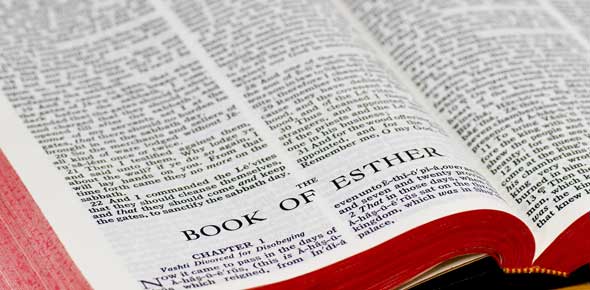
My favorite book from the Old Testament: Esther was the Jewish Queen of the Persian King Ahasuerus, who averted the genocide of her people.
I imagine that it is this dual attitude of both suspicion and appreciation that drew me to Church Going. Never before had I found a poem that so perfectly captured my conflicting emotions. Much like I do, Larkin had a skeptical attitude towards Christianity and organised religion. In Church Going we can see him detail his own struggles while stopping to visit religious houses. As I have discussed in previous posts, Larkin is quite famous for his often brutal language, frequent profanity and the occasionally overwhelming sense of not caring very much at all. While sometimes this is exactly what you might need, there is something in the curious respect that reverberates throughout every line of Church Going that I have always loved. The poem begins with Larkin making sure the building is empty and that “nothing is going on” before he slips inside. Once he is inside Larkin is affected by the atmosphere despite himself and admits that even though he did not have a hat to remove, he instead takes off his “cycle clips in awkward reverence”. (The cycle clips mentioned are a well known ‘Larkin feature’, and were hugely associated with the poet during his lifetime.) I have always found this admission to be deeply revealing. Here we see Larkin purposely paint himself as an interloper, uninformed and slightly uncomfortable.It shows a softer side of the poet, one capable of respect even without personal investment. In Church Going the reader can see the Larkin that personal friends like Maeve Brennan knew; the calmer, perhaps even shy, poet and man looking for purpose in odd places.
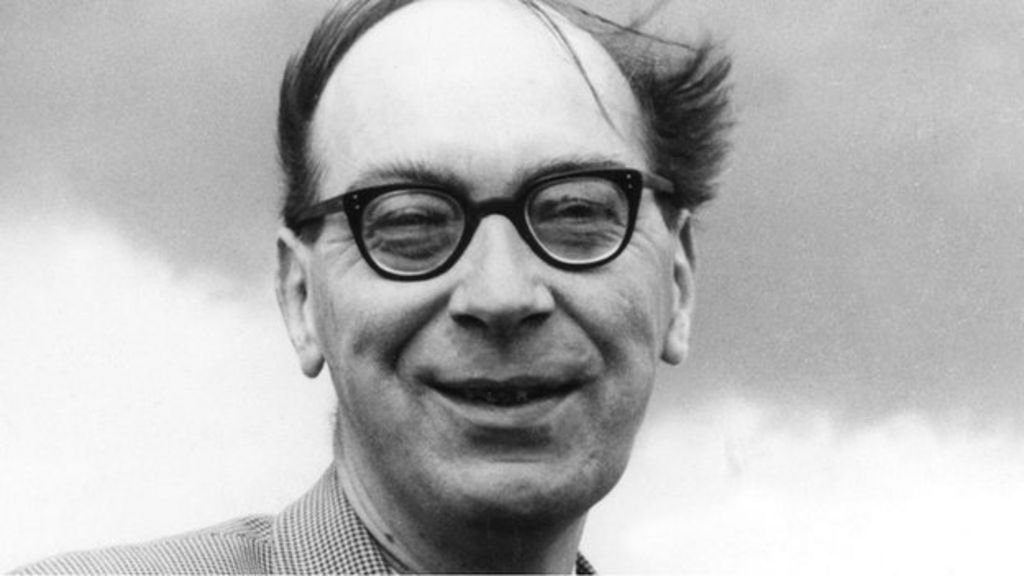
A rare image of the man himself laughing / credit James Booth
Church Going is Larkin at his softest but it is (thankfully) not without his humor. Note the poet’s observation that the silence was “brewed God knows how long”; while of course, God could quite literally know how long is has been silent, it is also the poet’s gentle way of showing his indifference. This line has also always seemed somewhat philosophical to me. Much like the silence’s length, only God knows how many men have stood in it, searching for answers just as Larkin did. Larkin himself declares that he is “at a loss” about what he is truly seeking every time he finds himself in churches, eventually concluding that perhaps he is drawn there simply because so many others have felt the same lure before him. Church Going is, in the poet’s own words, “not religious at all”, and this is important. Note that there is zero mention of either Jesus Christ or heaven and hell. It is fascinating how a poem can muse on and quite literally in churches, yet under the surface is about a faith that transcends all organised religion.
Larkin had a deep appreciation for English ecclesiastical architecture (who honestly hasn’t looked up awe struck when stepping into a Cathedral?) which lead him to wonder what will happen when churches begin to fall into disrepair and ruin, if the time comes for their place in society to be rendered “obsolete”. However, it soon becomes clear that Larkin is deeply aware that faith is more than a building, or a cross, or “some brass and stuff”. Faith can never be obsolete, thus making churches a ground “proper to grow wise in”, even if their function as a place of religious worship is eroded over time. Here, is perhaps where I note the real reason Church Going has remained so dear to me; it was one of the first pieces of poetry to mark a clear distinction between faith and religious worship. It also led me to understanding the difference between spirituality and religion, an understanding crucial to my sense of self. I have faith that I will see my friend again. It is something I know, deep in my soul. That faith does not come from the pulpit, or from a pew. It comes from my deep belief that there is love, there is legions, and there is a life after this one. Yet I, like Larkin, stop in churches from time to time if only to dip my toes in the water. I am glad I live in a world where I can do both.
John Muir, Scottish-American Naturalist on Nature and God / image from Pinterest
In a small aside, Larkin’s name was only added to the famous poet’s corner of Westminster Abbey in December 2016, exactly 31 years after his death. During the ceremony to add Larkin’s name, the Dean of Westminster Abbey, the Very Revd Dr John Hall spoke beautifully about Larkin’s right to be included, words I feel tie in well with the rest of my post!
‘Larkin himself had no strong faith, if any at all, but in Church Going and also in An Arundel Tomb, he’s thinking about the significance of the Church. There’s a sort of nostalgia there for faith and a sense that if the church disappears we will have lost something very important. Larkin’s engagement with this question is very important and it’s fitting that he’ll take his place at the heart of our church.’
Dean of Westminster Abbey, Dr John Hall / Adding Philip Larkin to the Poet’s Corner
I will attach here an audio clip of Larkin himself reciting Church Going; not a veiled message in support of Christianity, but rather a simultaneously serious and ironic reflection on the power of faith.
Church Going read by the poet
I also wish to attach this beautiful painting of Queen Esther: one of the first women I truly admired. Thank you for reading!
Welcome back! A shorter gap between posts this time, and a slight break away from Philip Larkin. However, I can’t promise that he won’t make a sneaky appearance here! Last Sunday night (January 10th) marked the 92nd Academy Awards; better known as The Oscars, or the biggest night of the year for the film industry. The Academy Awards are always a highlight of the year for my family and I. We have countless discussions about the nominated films/actors/directors and our predictions and preferences! I think its fair to say that I am an established Joaquin Phoenix superfan: I have watched all of his films, some multiple times. The first Phoenix performance I ever watched was his turn in Gladiator, as the amoral and power hungry Commodus, son of Marcus Aurelius. Phoenix’s depiction of Commodus earned him an Oscar nomination for Best Supporting Actor, an award that, at least in my humble opinion, should have been his. Gladiator is one of those rare films that once you have seen it, it remains in your mind, even if years have passed. And while I commend and laud Russell Crowe’s sensational performance as Maximus, it is Phoenix who stands out. As a child I was equally fascinated and terrified by Commodus’ sneer and his sheer delight in the savagery of the Colosseum; who could forget the utterly iconic thumbs down scene?
Phoenix as Commodus (Gladiator 2000 directed by Ridley Scott)
Unfortunately for Phoenix and his legion of fans, his loss at the 2001 Academy Awards was only the beginning of award season disappointments. This leads us to perhaps one of the greatest performances of the last 20 years: Phoenix as musician Johnny Cash in the 2005 masterpiece Walk The Line for which he received his first Best Actor nomination. Arguably one of the most notorious Oscar snubs, Phoenix lost to the sadly departed Philip Seymour Hoffman for his role in Capote. As an avid true crime fan I loved Capote, and Hoffman was one of the best of his generation. But Phoenix embodied everything I both loved and hated about Johnny Cash, a musician who was one of the most formative sounds of my childhood.
The final loss, and perhaps the most heartbreaking one for Phoenix himself, came in 2013. Phoenix was once again nominated for Best Actor, this time for his phenomenal performance in The Master, where he plays an alcoholic Navy Veteran struggling to adjust to life following the Second World War. In an interesting aside, Seymour Hoffman stars alongside Phoenix here and was nominated for Best Supporting Actor; a fun detail considering their contentious battle in 2005! Daniel Day-Lewis beat Phoenix to the prize this year, a decision that I still stand by as the wrong one. Day-Lewis is the all time great, an absolute acting powerhouse, knighted for his services to drama. Yet I still struggled to sit through his performance in Lincoln, for which he not only beat out Phoenix, but sealed his status as the only male actor to receive three Best Actor Oscars. Of course, countless fans and critics loved Lincoln, and found it riveting. I was not among that number. However, I have to acknowledge that such drastically differing opinions are part of what makes film and the discourse around it so wonderful and so compelling. Daniel Day-Lewis is not for everyone, but neither is Joaquin Phoenix. Of course, Oscar snubs are not exclusive only to Phoenix; consider how unsuccessful Tom Cruise has been despite his three nominations, and countless memorable performances. Rain Man? Born on the Fourth of July? A Few Good Men? Magnolia? They all still hurt.
This leads me to 2020 and Phoenix’s award season clean sweep for the film everyone could not stop talking about, Todd Phillips’ Joker. I will spare you my ramblings on Joker, which was perhaps my favorite film of 2019; only because I already wrote a blog post on it! You can find it here 🙂 I say it was perhaps my favorite of the last year; I also adored Knives Out, which came as a surprise to me. Highly recommend watching if you haven’t already!
It is may be fair to say that Phoenix seemed the sure winner this year. He had successfully won the Golden Globe, the BAFTA, and the Screen Actors Guild Award. He had weathered the inevitable storm that came with Joker’s controversial themes, and charmed the world with understated adoration of his fiance Rooney Mara. Humor me and watch his love for her at the Golden Globes; its a small moment of beauty in our topsy-turvy world.
Phoenix acceptance speech Golden Globes 2020
Surely this year it was his turn to be Leonardo DiCaprio, to win the Best Actor trophy, and to escape the DiCaprio curse of gracious reactions and air of someone-else-always-wins-oh-my-god-what-can-I-do-but-clap-when-will-it-be-my-turn. This air of certainty does not make his win any less special; the Academy have pulled the rug out from underneath many actors, something which Phoenix knows all too well. He still looked incredibly nervous in the moments before the winner was announced, an uncertainty that is nothing but endearing. Now we arrive at what is perhaps the real reason I am writing this post; Phoenix’s acceptance speech. I will link it here: please do watch it so that my next few reflections make complete sense!
Joaquin Phoenix 2020 Academy Award’s Best Actor Acceptance Speech
I can not claim to be perfect; none of us can, not even those with wealth, fame and privilege beyond our wildest dreams. It is why Larkin’s poetry has always been so important to me. He was a man who acknowledged his imperfections, even if those acknowledgements were masked with sarcasm. (Sneaky mention spotted). I state once again that I am far from perfect, and that I do not want any piece of this post to translate as preachy or entitled. Phoenix went viral for his politically charged BAFTA acceptance speech, is a prominent activist for animal rights and champions the vegan cause. Phoenix’s substantial track record of protesting for animal rights is nothing short of inspiring; this is a man who puts his money where his mouth is, visiting slaughter houses and joining public protests as opposed to the press trail the day after scooping a prestigious award. Many have come out against Award show speeches becoming political or too on the nose, but this is a stance I utterly disagree with. Some of the talented and creative among us have been lucky enough, and driven enough, to carve out a platform from which they can invoke real change; to not utilise these opportunities would be a travesty. Somehow, almost before we realised it, we have come to live in a world that is harsh on any type of mistake. Call it cancel culture, call it call out culture; it exists, it is real, and often causes more harm than good. I was so glad to see Phoenix address this with such empathy and wisdom:
I’m grateful that so many of you in this room have given me a second chance. I think that’s when we’re at our best: when we support each other. Not when we cancel each other out for our past mistakes, but when we help each other to grow. When we educate each other; when we guide each other to redemption.
Joaquin Phoenix 2020 Oscars
The world is a scary place; it always has been, albeit for differing reasons from generation to generation. More kindness, and a greater willingness to understand one another is needed now more than ever. I urge everyone to revisit Phoenix’s speech in the above video from the 3:05 mark on: it is here that he acknowledges his brother, the late River Phoenix, and a lyric that he wrote when he was only 17 years old. Seeing Phoenix lose his composure and the visible grief in his eyes, cut almost a little too close to the bone. Joaquin lost River to a drug overdose, when the latter was only 23 years of age. River too, was a talented actor with a bright future, best remembered for his role in the seminal coming of age movie Stand By Me. I do not wish to delve too deeply into my own pain and grief, but I would think it lax to not acknowledge how profoundly the final few moments of Phoenix’s speech impacted me. My family knows only too well the struggles and trials of loving, and ultimately losing, a son and a brother to addiction. My loss comes in the form of estrangement, and while different to the finality of River Phoenix’s death, it is an ache that weighs so heavily on my heart some days I think I may collapse. I have striven to make like Phoenix and run to the rescue with love, even when love was not enough. I hope with all my heart that some day it can bring me back what I have lost, and that peace will indeed follow. Grief is a curious, and bitter monster; it shapes and changes us in ways we may not even know. Cassandra Clare wrote the following:
They say time heals all wounds, but that presumes the source of the grief is finite.
Cassandra Clare / Clockwork Princess
I have made it my mission to not allow grief to make my heart hard and cold: love and kindness are the most precious gifts we can give. Of course, it is not realistic to expect everyone to be their best selves every day. I simply try to be the best I can when the moment presents itself, ultimately remembering that we are all fighting battles no one else can see. Thank you for reading! ❤
Recommended Watching:
You Were Never Really Here – available on Netflix as of recently!
The Master – mentioned above, a tough watch but worth it
Walk The Line – mentioned above, even google clips on YouTube to see Phoenix and Witherspoon’s transformations into Cash and June Carter!
Stand By Me – most likely seen it, always worth a rewatch!
As part of our EN6009 module, my classmates and I had to edit a Wikipedia article of our choice, and live tweet the process. After giving the assignment some thought, I settled on editing the article on the Relationships that Influenced Philip Larkin. I’ll attach a link here!
As I have started researching my thesis topic more extensively over the last few weeks, I had noticed that this particular wiki was scarce on information about many of the (predominantly female) relationships that had influenced Larkin’s life and poetry. There was a particular lack of information on Maeve Brennan, a close confidant of Larkin’s for close to three decades. Monica Jones was arguably Larkin’s most famous love interest; this could be seen in the Wiki, with substantially more information available on Jones and her dynamic with the poet. With this in mind, I set to filling in some information on Maeve Brennan! In the screenshot below you can see the initial section on Brennan (I know, phone screenshots are the worst, sorry) which was pretty basic.
Initial Information on Maeve Brennan – fairly sparse!
My first major edit to this section was filling in some missing details about Brennan’s early life. In a small but interesting aside, Maeve’s father, a dental surgeon, was actually from County Kilkenny! Brennan, however, was born in Beverley, East Yorkshire. I was fascinated to learn that Brennan was evacuated from her home place during World War 2, only returning to Hull, where she would later meet Larkin, for her second level education. Speaking of education, any information on Brennan’s academic career was also missing; she was head girl during her tenure at Saint Mary’s High School for girls, and graduated with a degree in history, French and English from Hull University. I found Jean Hartley’s beautifully written obituary for Maeve particularly useful when compiling information on her early life; you can read it here!
Here you can see additional information about Maeve’s early life and education!
I then moved onto adding information about Maeve’s relationship with Larkin; I was glad to be able to emphasise that while Brennan’s romantic relationship with Larkin lasted for 18 years, their unique friendship spanned three decades; there was much more to Larkin and Brennan than simply a love affair! I also added information on Brennan’s particular impact on Larkin’s poetry; he was in fact, heavily influenced by their relationship. This is particularly evident with his collection The Whitsun Weddings, which he once described as Maeve’s book! (“You know The Whitsun Weddings is your book, don’t you”.)
Additional information on Maeve’s dynamic with and influence on Larkin
Perhaps the most surprising omission from this subsection was that of Maeve’s memoir, The Philip Larkin I Knew, which was published in 2002. There was absolutely no mention of it! However, I do feel lucky to have been the one to add this information in! The memoir is a deeply personal and revealing account of Brennan and Larkin’s romantic relationship, and their unique friendship. I felt it was vital to add information on this book to the Wiki! Not only is it beautifully written but it is also a key part of the efforts made to show a new side to Larkin, to fight back against the tarnishing of his reputation. Larkin’s legacy and critical reputation suffered significantly following his death, an issue which Brennan directly addresses in her memoir. The Philip Larkin I Knew also contains a large number of letters Brennan exchanged with the poet; these are at once intimate and revealing, yet also show a truly funny side to the poet, as well as highlighting just how substantial the space Maeve occupied was.
I have also discussed Brennan’s relationship with Larkin in a previous blog post if anyone wants to take a look!
Information on Brennan’s memoir The Philip Larkin I Knew as well as her work on documentaries
Adding all of the above information on Maeve Brennan actually took a surprising amount of time! As our class was only two hours, my other edits were not quite as substantial. I provided a few missing citations (for example the excellent Letters to Monica edited by Anthony Thwaite) and also cleared up some grammar and syntax issues in the opening lines. Editing this Wiki also sent me down a slight rabbit hole that evening! I had not previously read too much about Larkin’s relationship with the novelist Kingsley Amis; reading some more of their letters was intriguing. Isn’t Kingsley Amis just such a great name? Sounds like he should be in the Order of the Phoenix. I tidied up some slight wording issues in the brief section on Amis and his son, Martin. These edits can be seen below!
The original and brief note on Amis
Updated note on Kingsley Amis
I was also hoping to add some more information on Larkin’s mother, Eva, but sadly did not have enough time. I was only able to put in a few short notes about the mother/son dynamic, but every contribution helps!
Overall, I enjoyed the editing process much more than I thought I would. Live tweeting also added a fun and interactive element to the whole class; it was lovely to see my peer’s research interests and sparks of their personality and humor coming across in their tweets! I definitely enjoyed adding my own touch to the Wiki; it is also nice to see that 24 hours later none of my additions have been contested or removed. For anyone interested in reading some of the pieces mentioned here, I’ll provide a brief list below 🙂 Thank you for reading!
Works Mentioned / Recommendations:
The Philip Larkin I Knew – Maeve Brennan * available on Amazon
Letters to Monica – Philip Larkin / edited by Anthony Thwaite * a recent Irish Times article worth reading!
The Whitsun Weddings – Philip Larkin * here is a link to the titular poem ❤